Barium lab
Spontaneous emission of radiation is the process that governs how matter scatter light making objects visible. Visibility is at the core of our senses and its control is amenable for microscopy, optomechanics and quantum information. In many quantum applications, it is accepted that the natural process of spontaneous emission sets the ultimate limits for measurements and operations because the emission is viewed as an inevitable form of decoherence emerging from the coupling of the quantum system with the enviroment. We want to change this perspective and, in one research line we follow, we tackle the problem of suppressing and controlling spontaneous emission to an extend relevant for future quantum applications.
In addition to this, our research involves also the usage of barium for quantum information processing. In the following sections we delve a bit deeper into the following topics:
- Invisibility of an atomic ion
- Quantum information processing with barium ions
- Antimatter at low energy
- Optomechanics with dipolar scatterers
Invisibility of an atomic ion
We want to control the spotanoues emission of a levitated atom with a hemispherical mirror. The mirror is used to reflect part of the emitted radiation back onto the emitters to interfere with the on-going process of emission. This design can achieve much larger suppression of SE than a cavity QED system thanks to the possibility to control the emitted light from all the directions of space. With our mirror [1], we plan to suppress the emission rate by 96% entering in a new regime where applications are possible. This result will enable us to extend the lifetime of optical clocks, engineer qubits on dipole transitions, change the way atoms decay when excited, and a lot more [2].
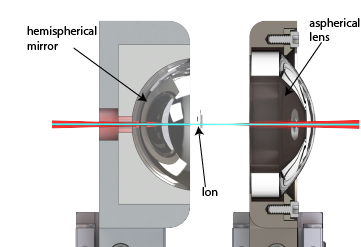 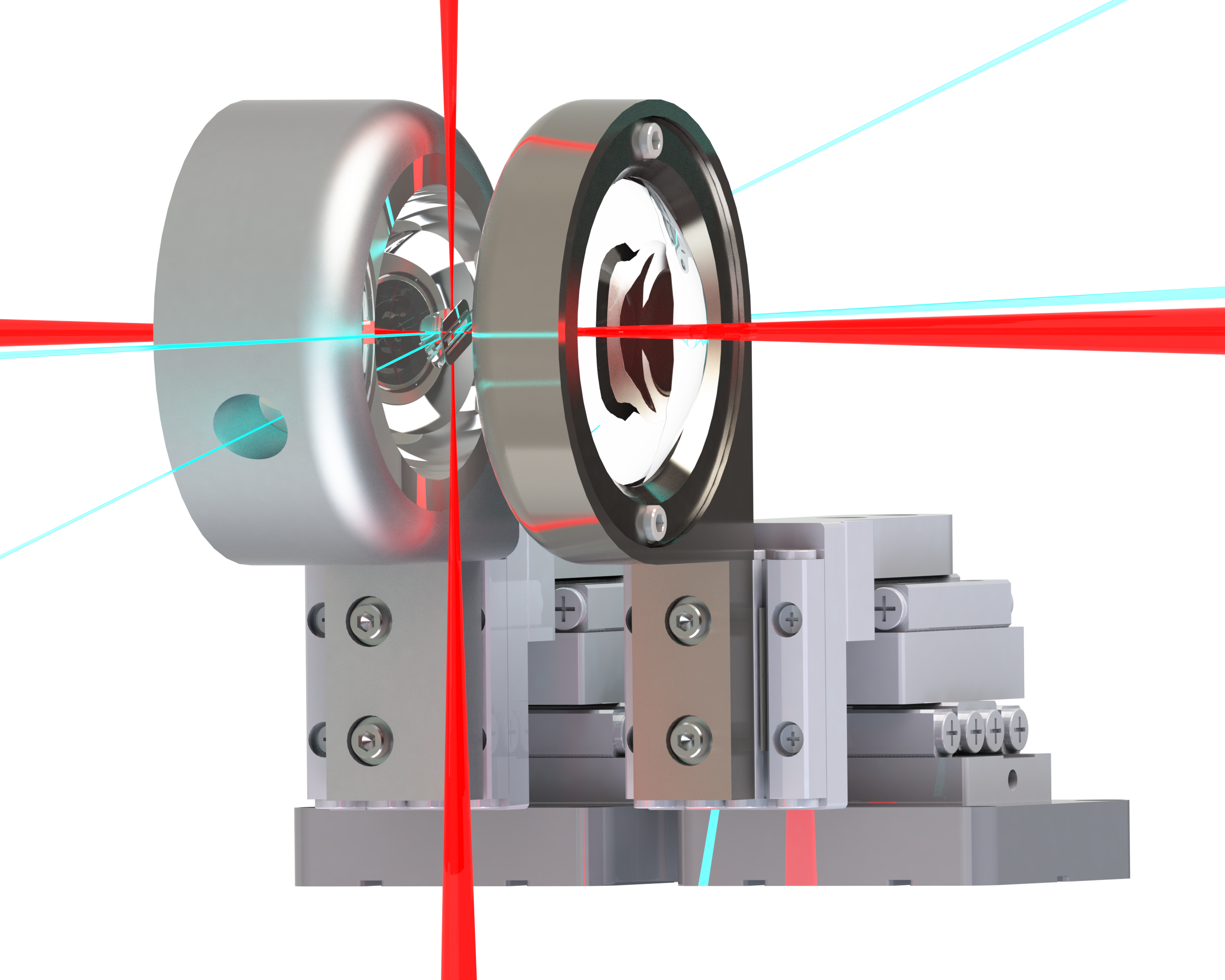 |
In addition to a higher light collection efficiency, this new design will allow us to study phenomena such as the strong inhibition of the spontaneous decay, and the enhancement of the emission rate of the ion [2].
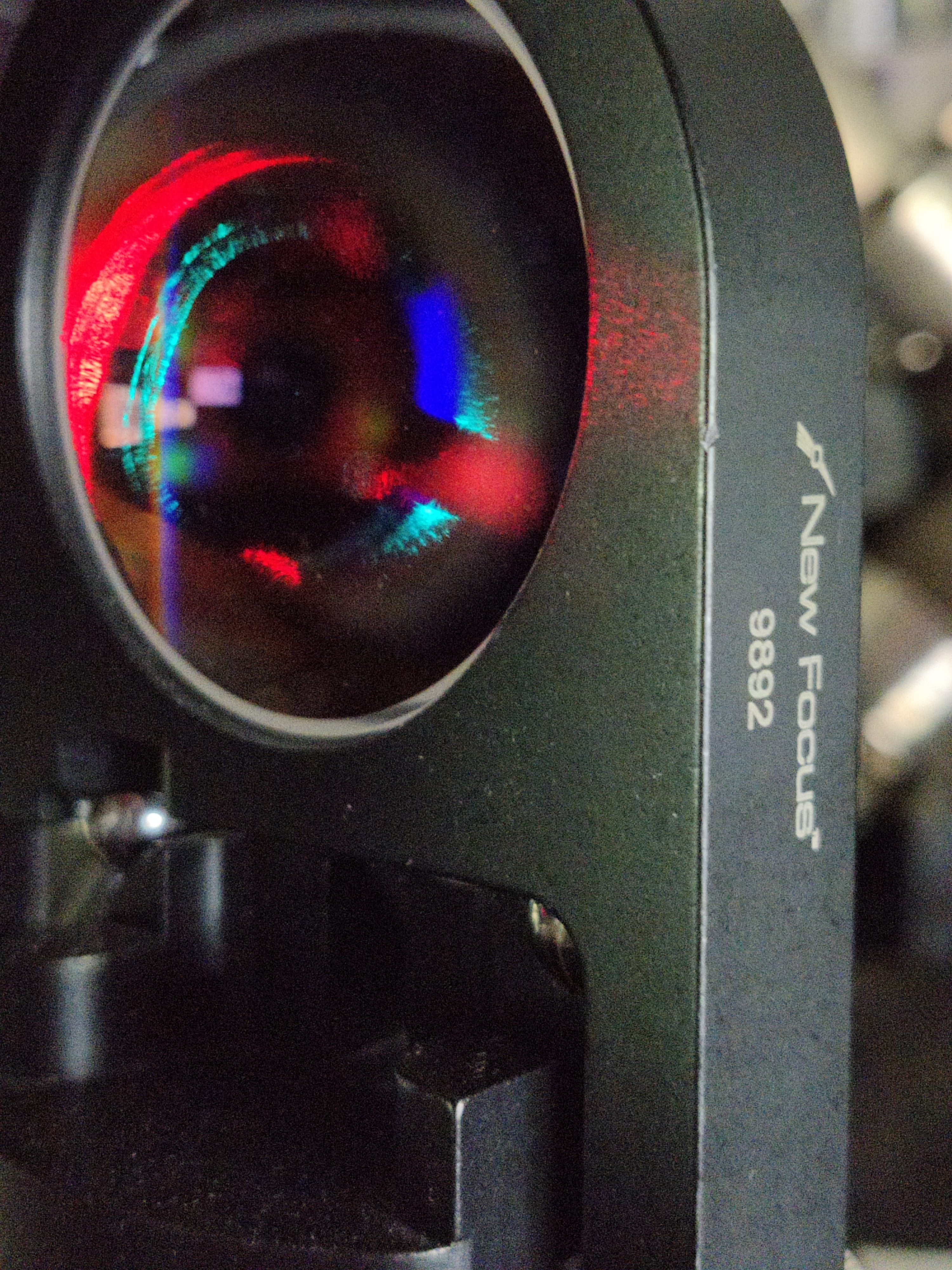
Have a look at a single ion in the Panopticon setup!
References
[1] D. Higginbottom, G. Campbell, G. Araneda, F. Fang, Y. Colombe, B. C. Buchler, P. K. Lam, Sci. Rep. 8, 221 (2018)
[2] G. Araneda, G. Cerchiari, D. B. Higginbottom, P. C. Holz, K. Lakhmanskiy, P. Obšil, Y. Colombe, and R. Blatt, Rev. Sci. Instrum. 91, 113201 (2020)
Quantum information processing with barium ions
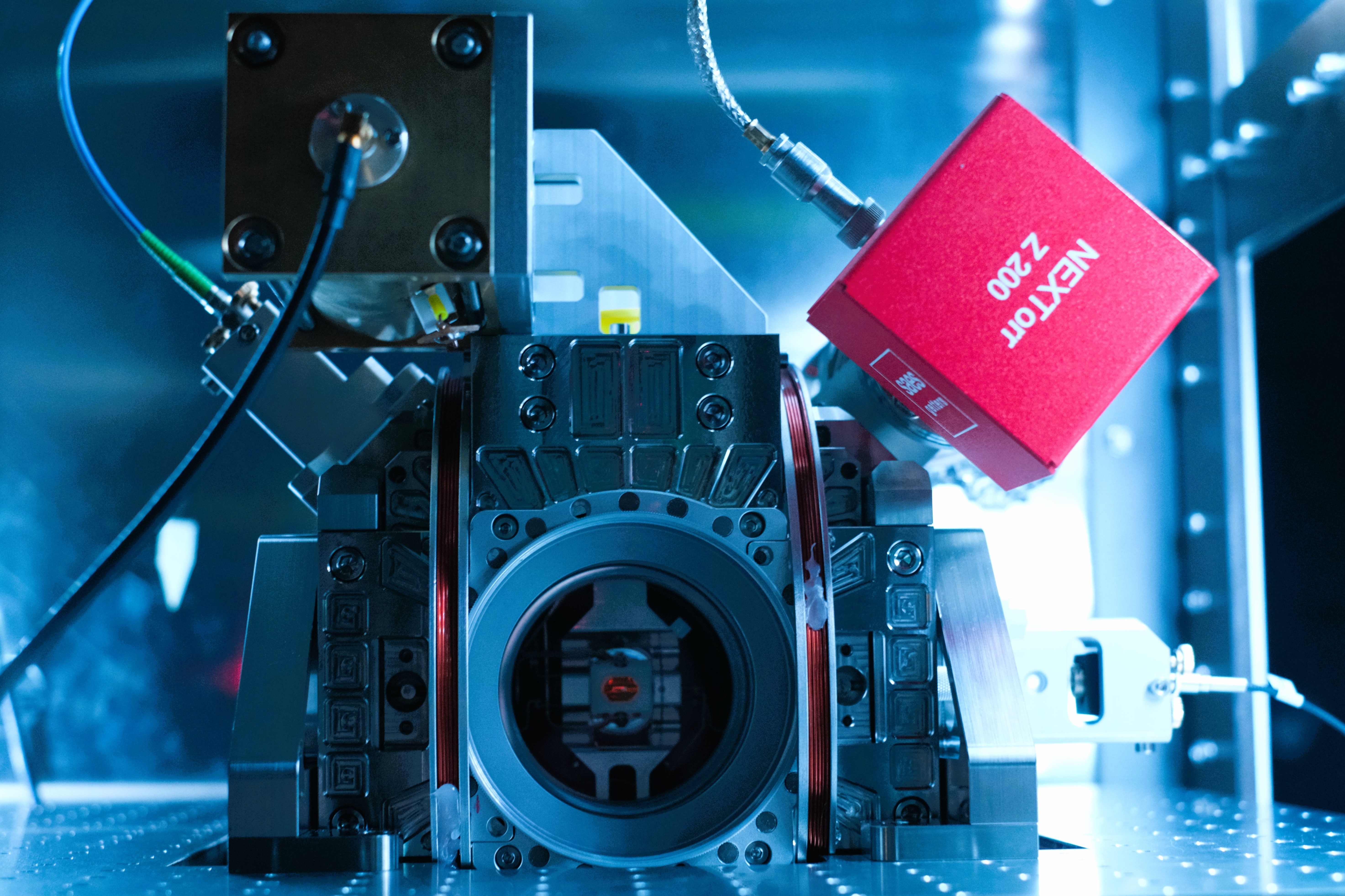
Trapped ions are among the most promising candidates for the near-future realization of quantum computers. In this computers, the unit of quantum information (qubits) are encoded into the electronic quantum states of trapped ions. To perform a computation, the information encoded in the qubits is elaborated and exchanged via quantum operations that are realized by carefully illuminating the ions with precise laser pulses. Altough many atomic ions can be used as qubits, we think that 137Ba will offer a decisive advantage to perform the quantum operation with outstanding fidelities allowing to extend the complexity of the quantum calculations beyond the design of current architectures. Our experiment Hyperion is built around this, and its goal is exactly to demonstrate high-performances only achievable with Barium ions.
  |
CARONTE - Compact AntipROtoN Transfer dEvice
Researchers who are interested in studying and developing future technologies based on Antimatter are currently limited by the availability of antiprotons, which can only be accessed at CERN in Geneva. This limitation greatly discourage the development in this field because of the added costs in terms of resources and time that emerge from having to develop innovation physically at CERN. To solve this problem, we are developping a prototype to trasport antiprotons from the CERN’s facilities to any other institution.
project supported by: 1669 Prototypenentwicklung des Förderkreises 1669
Optomechanics with levitated dipolar scatterers
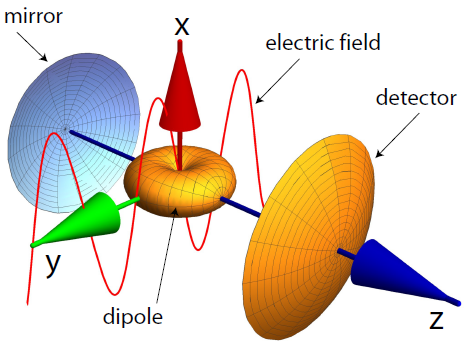
The study of levitated dipolar scatterers is a growing field in physics that promises to uncover the connection between quantum mechanics and gravity, to access the QED forces exert on atoms by external boundary conditions and to deliver future devices for ultra-precise force sensing. In collaboration with the nanosphere team of the QI group, we investigate how the measure the position of these scatterers by controlling their spontaneous emission (SE) with a spherical mirror. Developing on the experience of atomic experiments [3, 4], we applied our method to a silica nanoparticle [1, 2]. This technique, unlike other state-of-the-art techniques, can reach the Heisenberg limit of detection, i.e. when the position measurement is only bounded by the recoil force of the scattered light.
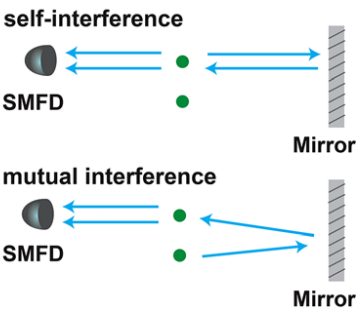
The setup splits the solid angle surrounding the scatterer into two regions as depicted in the figure. Half of the solid angle is occupied by a mirror and half by a detector. The mirror produces an image of the dipolar scatterer that interferes with the primary emitted field at the detector. This configuration realizes the self-homodyne of the emitted field by self-interfering each emitted photon. Self-interference allows controlling the SE of the scatterer while obtaining superior mode-matching of the radiation fields for homodyne detection. The radiation exists from the scatterer-mirror system only from one side enabling the measurement with only a single one-sided detector.
The new method is suitable for precision studies of any dipolar scatterer such as atoms and nanoparticles without requiring the existence of a complex electronic structure.The self homodyne configuration for detection can also be extended to sense the motion of an ion chain as depicted in the following figure ions [3].
References
Project members
Dr. Giovanni Cerchiari (University Assistant - PostDoc)
e-mail: giovanni.cerchiari(at)uibk.ac.at
room: 4/08

Yannick Weiser (Ph.D. student)
e-mail: yannick.weiser(at)uibk.ac.at
room: 4/04

Lorenz Panzl (Ph.D. student)
e-mail: lorenz.panzl(at)uibk.ac.at
room: 4/12

Tommaso Faorlin (Ph.D. student)
e-mail: tommaso.faorlin(at)uibk.ac.at
room: 4/07

Phoebe Grosser (Ph.D. student)
e-mail: phoebe.grosser(at)uibk.ac.at
room: 4/04

Haonan Tian (Master student)

Walter Hörmann (Master student)

Sara Alfaro Campos (Master student)

Thomas Lafenthaler (Master student)
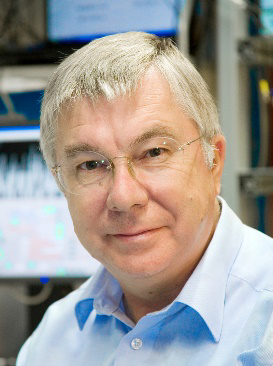
Prof. Rainer Blatt (senior advisor)

Picture of the Barium team (09/2025, Obergurgl)
Top row: L. Panzl, H. Tian
Bottom row: R. Blatt, T. Faorlin, P. Grosser, G. Cerchiari, T. Monz
Former members
Yves Colombe (senior scientist, now at Infineon technologies)
Gabriel Araneda (now at the University of Oxford, UK)
Lukáš Podhora (visiting PhD student from the Palacký University)
Daniel Higginbottom (PhD student, also with the ANU in Canberra, Australia)
Petr Obšil (visiting PhD student from the Palacký University)
Nicolas Chauvet (master student, ENS Lyon, France)
Lukáš Slodička (now at the Palacký University in Olomouc, Czech Republic)
Gabriel Hétet (now at the Laboratoire Pierre Aigrain, École Normale Supérieure, France)
Nadia Röck (now at the Univ. Klinik für Strahlentherapie-Radioonkologie, Innsbruck)
Sebastian Gerber (now at CERN on the AEgIS experiment)
Daniel Rotter (now at Swarovski Optik)
Publications
- "Towards metrology with highly charged isomeric ions from antiproton annihilation"
S. A. Campos, L. Panzl, J. Zieliński, S. Choudapurkar, F. P. Gustafsson, M. Germann, T. Faorlin, Y. Weiser, T. Lafenthaler, T. Monz, G. Kornakov and G. Cerchiari
J. Phys. B: At. Mol. Opt. Phys. 58 215002 (2025) (open access) - "Controlling the spontaneous emission and entanglement of quantum scatterers via modulated reflection of their emitted photons"
T. Faorlin, B. Yadin, G. Araneda, S. Nimmrichter, Y. Weiser, L. Panzl, T. Lafenthaler, R. Blatt, T. Monz and G. Cerchiari
New J. Phys. 27 064107 (2025) (open access) - "Backaction suppression for levitated dipolar scatterers"
Y. Weiser, T. Faorlin, L. Panzl, T. Lafenthaler, L. Dania, D. S. Bykov, T. Monz, R. Blatt and G. Cerchiari
Phys. Rev. A. 111, 013503 (2025) (open access) - "Positronium Laser Cooling via the 13S−23P Transition with a Broadband Laser Pulse"
L. T. Glöggler et al. (AEḡIS Collaboration)
Phys. Rev. Lett. 132, 083402 (2024) (open access) - "Synthesis of cold and trappable fully stripped highly charged ions via antiproton-induced nuclear fragmentation in traps"
G. Kornakov, G. Cerchiari, J. Zieliński, L. Lappo, G. Sadowski, and M. Doser
Phys. Rev. C 107, 034314 (2023) (open access) - "Position Measurement of a Levitated Nanoparticle via Interference with Its Mirror Image"
L. Dania, K. Heidegger, D. S. Bykov, G. Cerchiari, G. Araneda, T. E. Northup
Phys. Rev. Lett. 129, 013601 (2022) (open access) Featured in Physics - "Position measurement of a dipolar scatterer via self-homodyne detection"
G. Cerchiari, L. Dania, D. S. Bykov, R. Blatt, T. E. Northup
Phys. Rev. A 104, 053523 (2021) (open access) - "Measuring ion oscillations at the quantum level with fluorescence light"
G. Cerchiari, G. Araneda, L. Podhora, L. Slodička, Y. Colombe, R. Blatt
Phys. Rev. Lett.127, 063603 (2021) (open access) - "Motion analysis of a trapped ion chain by single photon self-interference"
G. Cerchiari, G. Araneda, L. Podhora, L. Slodička, Y. Colombe, R. Blatt,
Appl. Phys. Lett. 119, 024003 (2021) (open access), Full article. - "The Panopticon device: an integrated Paul-trap-hemispherical mirror system for quantum optics"
G. Araneda, G. Cerchiari, D. B. Higginbottom, P. Holz, K. Lakhmanskiy, P. Obšil, Y. Colombe, R. Blatt,
arXiv:2006.04828, Rev. Sci. Instrum. 91, 113201 (2020) (open access), Full article, Research News in Scilight - "Wavelength-scale errors in optical localization due to spin–orbit coupling of light"
G. Araneda, S. Walser, Y. Colombe, D.B. Higginbottom, J. Volz, R. Blatt, A. Rauschenbeutel
Nature Phys. 15, 17 (2019), Full articleResearch Highlight in Nature PhotonicsReseach News in OSA "Optics and Photonics News"
Article in La Scienze (IT)
Press Release - "Interference of single photons emitted by entangled atoms in free space"
Gabriel Araneda, Daniel B. Higginbottom, Lukáš Slodička, Yves Colombe, Rainer Blatt
Phys. Rev. Lett. 120, 193603 (2018), arXiv:1712.02105Press Release - "Fabrication of precision hemispherical mirrors for quantum optics applications"
D. Higginbottom, G. Campbell, G. Araneda, F. Fang, Y. Colombe, B. C. Buchler, P. K. Lam
Sci. Rep. 8, 221 (2018), arXiv:1706.07858 - "Pure single photons from a trapped atom source"
D. B. Higginbottom, L. Slodička, G. Araneda, L. Lachman, R. Filip , M. Hennrich, R. Blatt
New. J. Phys. 18, 093038 (2016), arXiv:1605.03774 - "Free space interference experiments with single photons and single ions"
L. Slodička , G. Hétet, M. Hennrich, R. Blatt
Chapter in Engineering the Atom-Photon Interaction, Springer, Berlin, 2015
ISBN: 978-3-319-19230-7, arXiv:1502.04302 - "Free-space read-out and control of single-ion dispersion using quantum interference"
G. Hétet, L. Slodička, N. Röck, R. Blatt
Phys. Rev. A 88, 041804(R) (2013), arXiv:1212.0810 - "Atom-atom entanglement by single-photon detection"
L. Slodička, G. Hétet, N. Röck, P. Schindler, M. Hennrich, R. Blatt
Phys. Rev. Lett. 110, 083603 (2013), arXiv:1207.5468 - "Shot-noise limited monitoring and phase locking of the motion of a single trapped ion"
P. Bushev, G. Hétet, L. Slodička, D. Rotter, M. A. Wilson, F. Schmidt-Kaler, J. Eschner, R. Blatt
Phys. Rev. Lett. 110, 133602 (2013), arXiv:1202.2307 - "Interferometric thermometry of a single sub-Doppler-cooled atom"
L. Slodička, G. Hétet, N. Röck, S. Gerber, P. Schindler, M. Kumph, M. Hennrich, R. Blatt
Phys. Rev. A 85, 043401 (2012), arXiv:1202.4559 - "Single atom as a mirror of an optical cavity"
G. Hétet, L. Slodička, M. Hennrich, R. Blatt
Phys. Rev. Lett. 107, 133002 (2011), arXiv:1105.1919 - "Electromagnetically induced transparency from a single atom in free space"
L. Slodička, G. Hétet, S. Gerber, M. Hennrich, R. Blatt
Phys. Rev. Lett. 105, 153604 (2010), arXiv:1005.3289 - "QED with a spherical mirror"
G. Hétet, L. Slodička, A. Glätzle, M. Hennrich, R. Blatt
Phys. Rev. A 82, 063812 (2010), arXiv:1009.2344
Theses
- Gabriel Araneda
Experiments with single photons emitted by single atoms
Ph.D. thesis, 2020. Download - Daniel Higginbottom
Atom-light couplers with one, two and ten billion atoms
Ph.D. thesis, 2018, Australian National University. Download - Lukáš Slodička
Single ion - single photon interactions in free space
Ph.D. thesis, 2013. Download - Nadia Röck
Quantum manipulation on the Barium quadrupolar transition
Master's thesis, 2011. Download - Sebastian Gerber
Quantum correlation experiments with resonance fluorescence photons of single Barium ions
Ph.D. thesis, 2010. Download - Daniel Rotter
Quantum feedback and quantum correlation measurements with a single Barium ion
Ph.D. thesis, 2008. Download - Pavel Bushev
Interference experiments with a single barium ion: from QED towards quantum feedback
Ph.D. thesis, 2004. Download - Christoph Raab
Interference experiments with the fluorescence light of Ba+ ions
Ph.D. thesis, 2001. Download